

Feeling Like a human post-it?

Let’s get you unstuck!
Being stuck is being in the stickiness of life. Embracing stickiness is really the first step and recognising where the stickiness shows up the next, is easy but not always the easiest to solve.
Ever feel like you’re running in circles? You’ve got ideas, ambition, and drive, yet something invisible is holding you back.
That’s stickiness, the mental or emotional glue keeping you stuck.
Stuck and sticky normally sit within the word change. Change is an instant defence mechanism that can trigger many into retracting into negative inner dialogue or I am not good enough, they don’t like me, I can’t do this or that, I should be this or that which then is self-fulfilling as we then go into the cycle of doom and sticky stuckness! Ever been there?
The good news? Stickiness isn’t permanent. It’s a signal, not a sentence.
Explore how to recognise your sticky spots, reframe them, and take bold action to get unstuck. Stickiness is that intangible resistance that keeps you tethered to the status quo. It’s not about external roadblocks, it’s about internal inertia. This could look like:
Overthinking every decision.
Avoiding risks because of fear of failure.
Feeling overwhelmed and unsure of where to start.
Knowing that something is off, just unsure what.
Stickiness isn’t exclusive to overthinking or indecision. It manifests across our lives in these sneaky ways:
The Busy Leader Syndrome: Constant firefighting rather than proactive planning. You confuse busyness with productivity.
Analysis Paralysis: Spending weeks debating a new strategy but never starting.
Fear-Based Leadership: Avoid difficult conversations because you’re scared of losing rapport with your team.
Cultural Compliance: Following company norms even when they no longer serve growth or innovation.
🛑 Sound familiar? Stickiness is your mind’s way of showing resistance to evolution.
Spot your sticky patterns.
Here’s a bold truth: the common denominator in all your sticky situations is you. Recognising this is empowering, not limiting. Let’s dissect:
Sticky Goals: You have a plan but no momentum because fear whispers, “What if this fails?”
Sticky Relationships: Patterns of avoiding conflicts with peers or team members to maintain superficial harmony.
Sticky Processes: Repeating outdated methods simply because “it’s how we’ve always done it.”
💡 Actionable Example: Use the H.A.R.A Technique (from your NLP toolkit) to centre yourself when overwhelm hits. Rate your issue on a scale from 1–10, and mindfully decrease its "stickiness" score as you shift focus from your head to your gut.
Why stickiness persists in leadership
Leaders are human. The higher up you go, the harder it gets to admit when you're stuck. Leaders often inherit the "I'll figure it out" mindset, creating a sticky web of isolation. Here’s why: The same qualities that make you effective like attention to detail, drive for perfection, and care for your team can also lead to paralysis when challenges arise.
Some common reasons leaders get stuck:
Fear of failure: “What if I make the wrong decision?”
Perfectionism: “I can’t act until everything is just right.”
Reactive loops: Constantly putting out fires leaves no space for forward movement.
Pressure to Appear Invincible: You’re the person people look to for answers, so admitting uncertainty feels like a weakness.
Defaulting to Survival Loops: You stay reactive because it feels easier than taking deliberate, forward-focused action.
Perfectionism Paralysis: Believing “good enough” isn’t good enough, so you tweak endlessly without ever delivering.
Real leaders confront this head-on. Stuck leaders stay stuck.

Get unstuck instant actions
Shake up your routine
Make tiny changes to disrupt autopilot thinking. Your brain thrives on novelty, and small shifts in routine can spark new ideas and perspectives.
Try This: Rearrange your desk or workspace. Put something inspiring in your line of sight—a photo, a bold quote, or even a plant.
Commuting? Take a different route, even if it’s longer. A fresh view out the window can unlock fresh thinking.
In Team Meetings: Replace the usual opening question, “What’s on the agenda?” with “What’s the one thing no one wants to talk about today?”
Reframe the fear
Fear feeds stickiness. Flip it into curiosity.
Think About This: Instead of asking yourself, “What if this fails?” ask, “What’s the best-case scenario if I try?”
Do This: Write down your top “What if” fears. For each one, add two potential “What’s possible?” outcomes.
Fear: “What if the team doesn’t like my decision?”
What’s Possible: “I gain respect for being decisive,” or, “We learn what doesn’t work and adjust.”
Ask yourself the awkward questions.
Sometimes, you’re the bottleneck. Get honest with yourself.
Self-Check Prompts:
Why am I really stuck? (Ego, fear, or avoiding discomfort?)
What role am I playing in this stuckness? (Are you enabling poor habits or dodging responsibility?)
What would someone else in my shoes do differently? (Imagine your boldest mentor or colleague.)
Action Step: Next time you find yourself stuck, grab a notebook and write down five possible reasons why. Circle the one that feels the most uncomfortable—it’s probably the truth.
Experiment with your beliefs
Your beliefs shape your reality. Test them.
Start Small: Write down one limiting belief you have, like:
“I need everyone’s approval to lead effectively.”
Challenge It: List 3 pieces of evidence that prove this belief wrong:
“My best ideas often came when I trusted myself.”
“When I act decisively, my team feels confident.”
Flip It: Replace your limiting belief with something empowering:
“I’m most effective when I act with clarity, not consensus.”
Visualise success, without sabotage
Sometimes, visualizing the result is enough to get moving.
Do This: Instead of focusing on all the obstacles in your way, take 2 minutes to imagine how success will feel.
What will your workday look like when you’ve handled the situation?
How will your team or organisation thrive because of your action(s)?
Bonus Action: Imagine how much worse things could get if you stay stuck. Use that discomfort as motivation to take the smallest next step
Another way is to use an acronym ( the joy of them is their simplicity ), and follow the S.T.U.C.K. formula to help you break free from stickiness:
S.T.U.C.K Formula
-
Self-awareness: Where am I the bottleneck in my growth?
Identify where you’re stuck. Is it a fear? A habit? A pattern?
Self-awareness is the first step to clarity.
-
DTools: What’s one underused tool in my leadership arsenal I can deploy today?
Use practical tools to shift your mindset:
The Swish Pattern: Replace a negative mental image with a positive one.
Journaling: Write down what’s holding you back and reframe it.
-
Unlearn: What legacy habits am I holding onto that no longer helping me?
Challenge limiting beliefs that keep you stuck.
Ask yourself, “Is this belief helping me or hindering me?”
-
Clarity: What’s the simplest next step forward?
Define what success looks like.
What’s the smallest, clearest step forward?
-
Kickstart: What micro-action can I take in the next 15 minutes to shift momentum?
Take action, any action. Remember, no action is an action too!
Momentum builds with movement, not perfection.
Want more practical steps to get unstuck today work on these:
Write down the one decision you’ve been avoiding and why.
Identify a small, actionable step to address it (e.g., schedule a meeting, or delegate a task).
Set a 15-minute timer and act.
Stickiness is your invitation to thrive
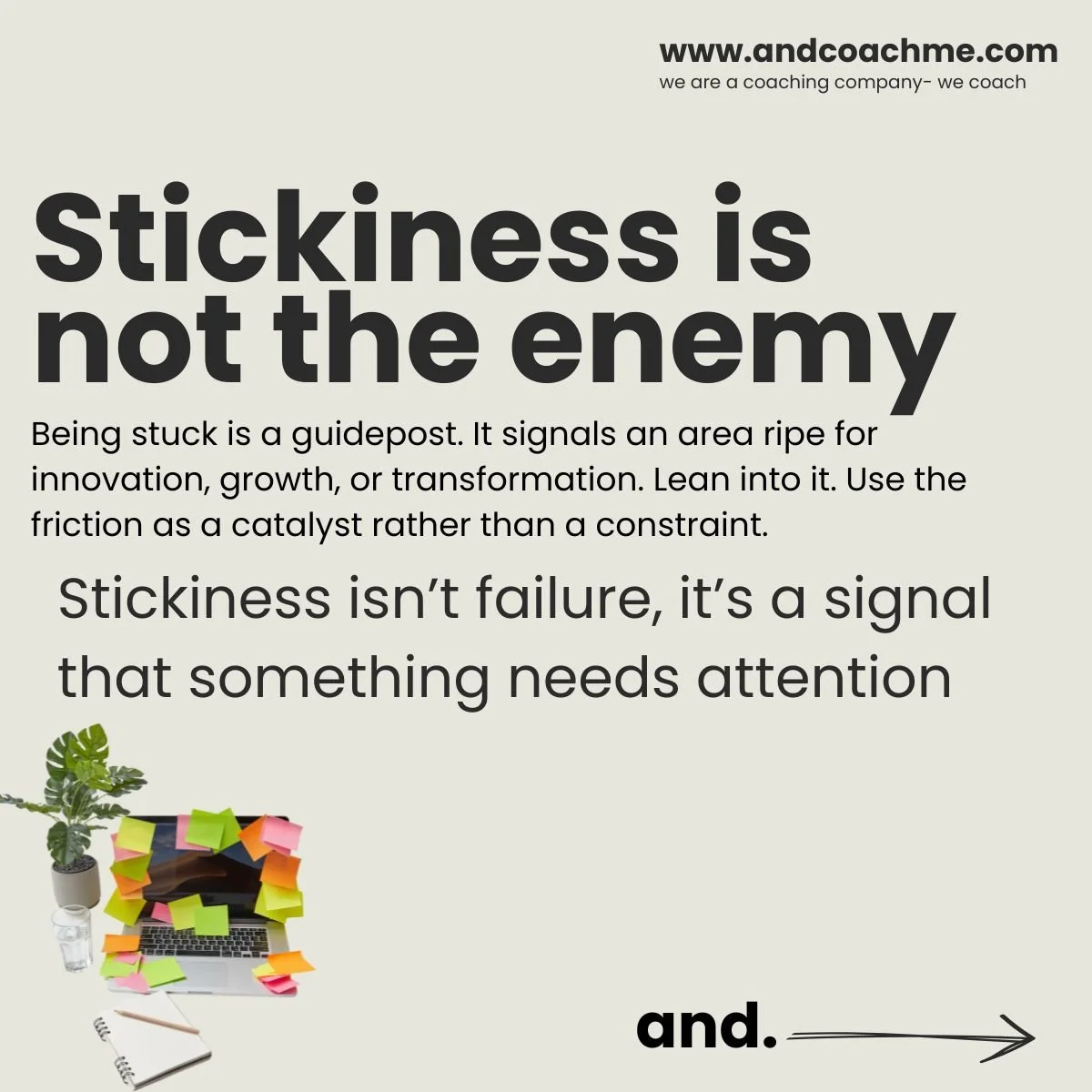
Stickiness is not the enemy; it’s the guidepost. It signals an area ripe for innovation, growth, or transformation. Lean into it. Use the friction as a catalyst rather than a constraint.
Identify one sticky spot in your life or leadership. Take a bold, imperfect action today to begin unsticking yourself.
Download the Unstuck Toolkit to explore proven techniques and exercises for breaking through mental and emotional glue
Please remember
Stickiness isn’t failure, it’s a signal that something needs attention.
The power to get unstuck lies within you.
By recognising the roots of your stickiness and applying the S.T.U.C.K., you can move from stagnation to momentum and from indecision to clarity.
Ready to stop the sticky and get unstuck?
Download our free Leadership Unstuck Toolkit and start moving forward today.
