

Daily consistency is the fastest way to kill momentum.
People are being told to be consistent in a way that fights how humans actually work.You just pretend they are not.
I have started with giving Board or Middle Managers options to delve into the challenge and problems you encounter first before you read the rest of the blog.
Because Boards need to stop exporting paradox and middle managers need to stop absorbing it silently. At and. or belief is leadership only works when tension is held at the right level. That is the work.
So let me begin with the reality that happens across business everywhere
Let me start with something that will sound uncomfortably familiar. “We just need people to be more consistent.”
It gets said in boardrooms, leadership “offsites”, and end-of-quarter reviews with a straight face. Usually followed by a nod. Sometimes followed by a sigh. Almost always followed by a plan that makes things worse.
Because what leaders usually mean by “consistent” is this.
Every day.
No gaps.
No pauses.
No excuses.
Daily updates.
Daily visibility.
Daily proof that something, anything, is happening.
It sounds sensible. It sounds grown-up. It sounds like leadership and because senior leaders love consistency, predictable delivery, aligned behaviour and a sense that things are under control. Yet real life is consistency demands in this form is one of the quickest ways to suffocate momentum.
Not because people are lazy.
Not because they do not care.
It’s because daily consistency is a single-truth idea being forced onto a messy, human, contradictory reality and reality does not bend just because a leadership team wants it to.
The moment momentum quietly dies
Here is a scene we see constantly.
A leadership team is frustrated. Projects start well, energy is high, and then things slow down. The diagnosis is immediate.
“We lose momentum.”
“People drop the ball.”
“They are not consistent enough.”
So frequency increases.
More check-ins.
More updates.
More meetings to “keep things moving”.
What actually happens next is predictable. People stop thinking and start reporting. They focus on being visible rather than effective, you get something every day, even when the work clearly needs space.
Progress does not speed up. It fragments. Everyone is busy. Nothing really moves. Momentum has not gone missing. It has been crushed under the weight of forced rhythm.
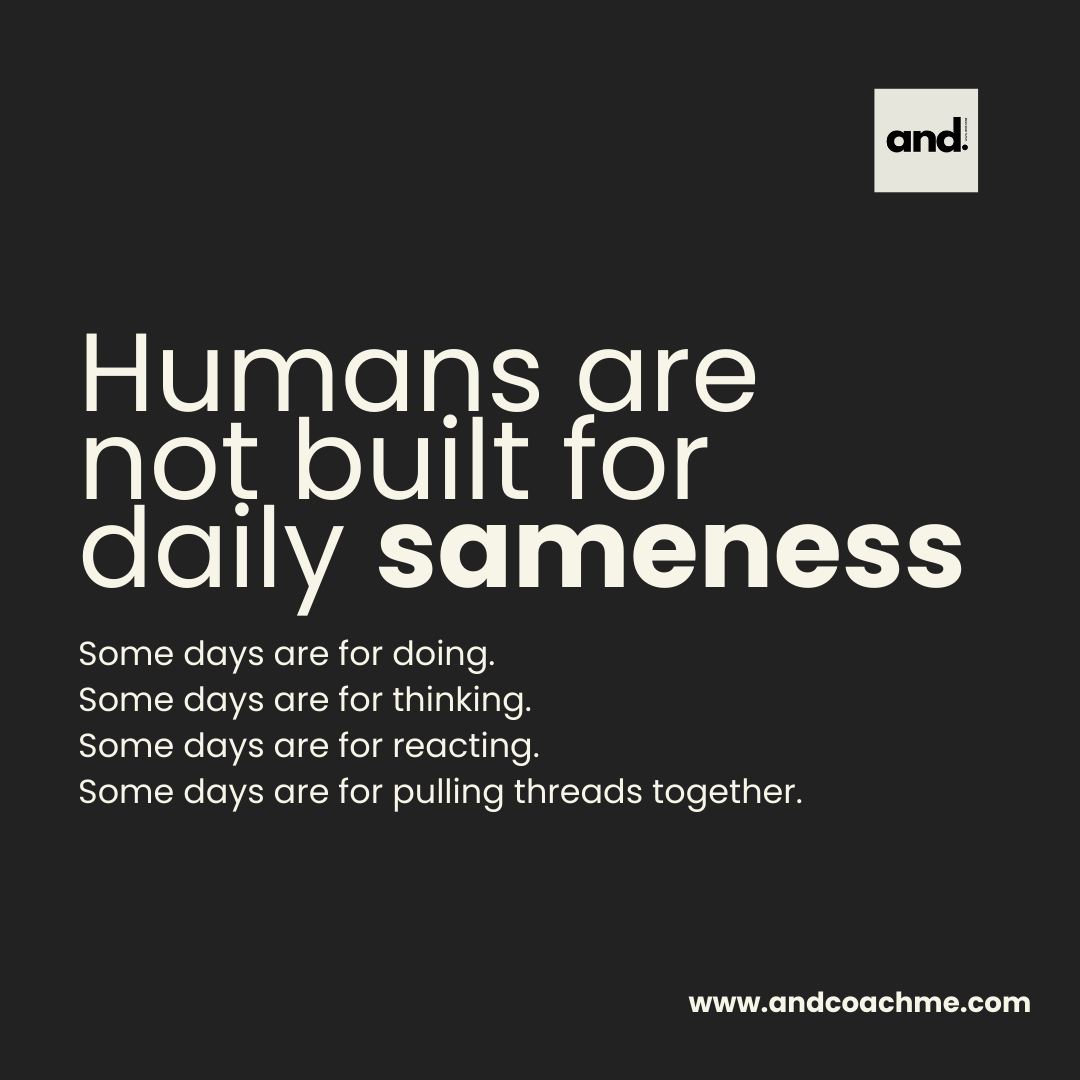
Humans are not built for daily sameness
This is the part leaders rarely say out loud, but everyone feels.
Some days are for doing.
Some days are for thinking.
Some days are for reacting.
Some days are for pulling threads together.
Daily consistency pretends those differences do not exist. It assumes effort resets neatly every morning, that focus is evenly distributed and that humans operate like machines. They do not.
So people adapt. Quietly. They perform activity. They send updates. They attend meetings they should not be in. They stay “on” when they should be off. From the outside it looks like consistency. From the inside it feels exhausting. This is how momentum dies without anyone quite noticing.
The language that gives the game away
You can hear this belief system in everyday organisational language.
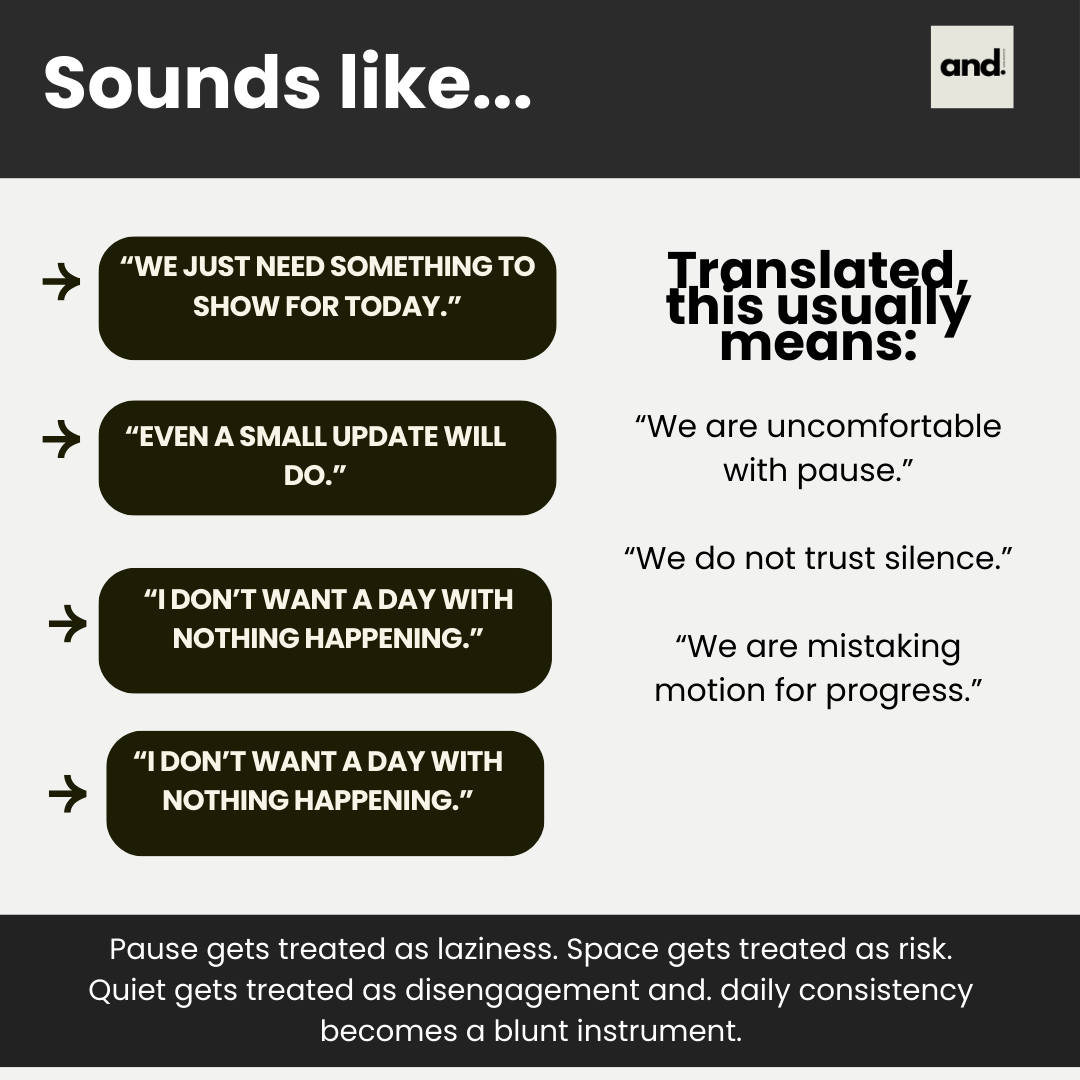
“We just need something to show for today.”
“Even a small update will do.”
“I don’t want a day with nothing happening.”
“Let’s keep the energy up.”
Translated, this usually means:
“We are uncomfortable with pause.”
“We do not trust silence.”
“We are mistaking motion for progress.”
Pause gets treated as laziness. Space gets treated as risk. Quiet gets treated as disengagement and. daily consistency becomes a blunt instrument.
Where and. actually sits in this
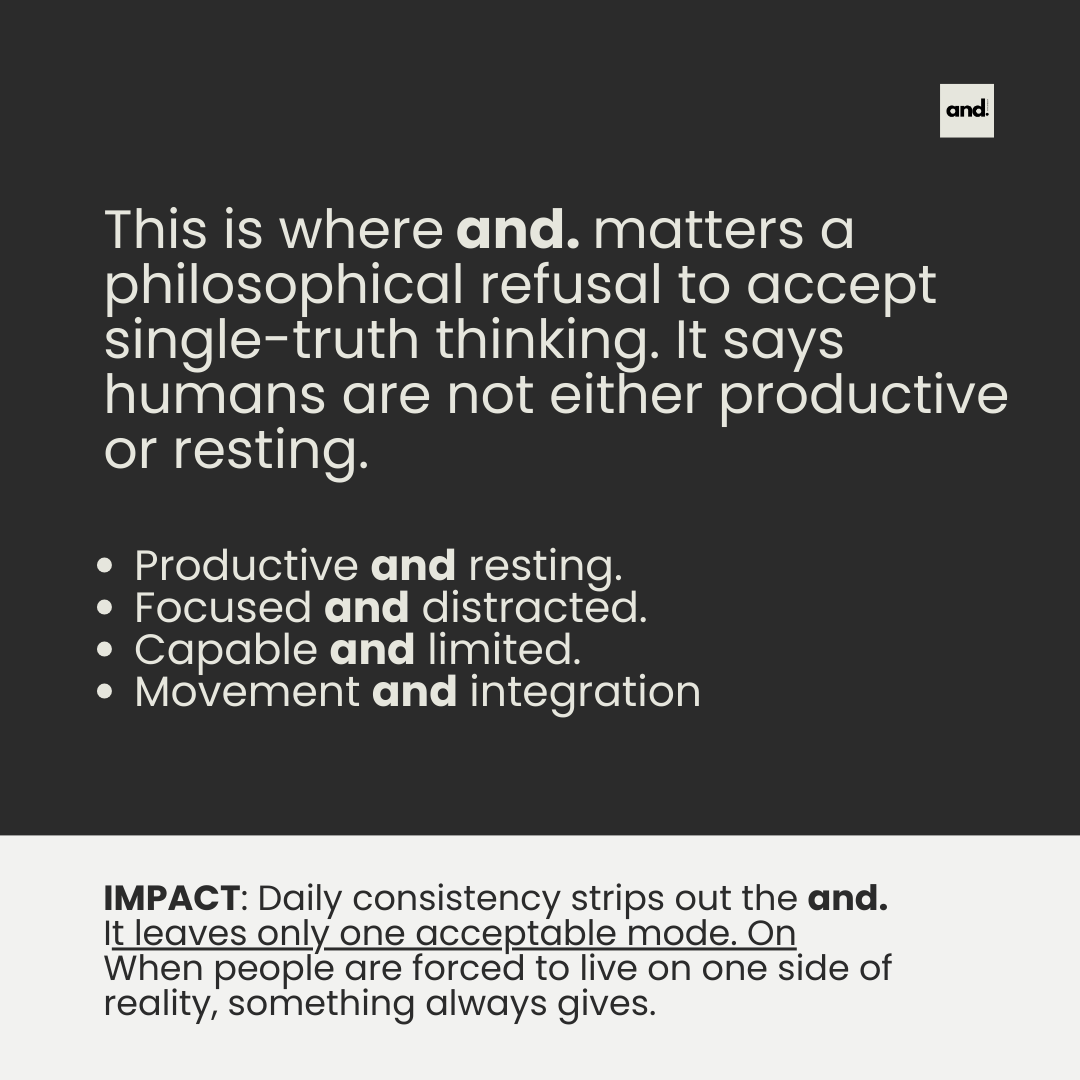
This is where and. matters. And no, not as a tool or a tactic. and. is a philosophical refusal to accept single-truth thinking. It says humans are not either productive or resting.
They are productive and resting.
Focused and distracted.
Capable and limited.
Momentum does not come from constant movement.
It comes from movement and integration.
Daily consistency strips out the and.
It leaves only one acceptable mode. On.
And when people are forced to live on one side of reality, something always gives.
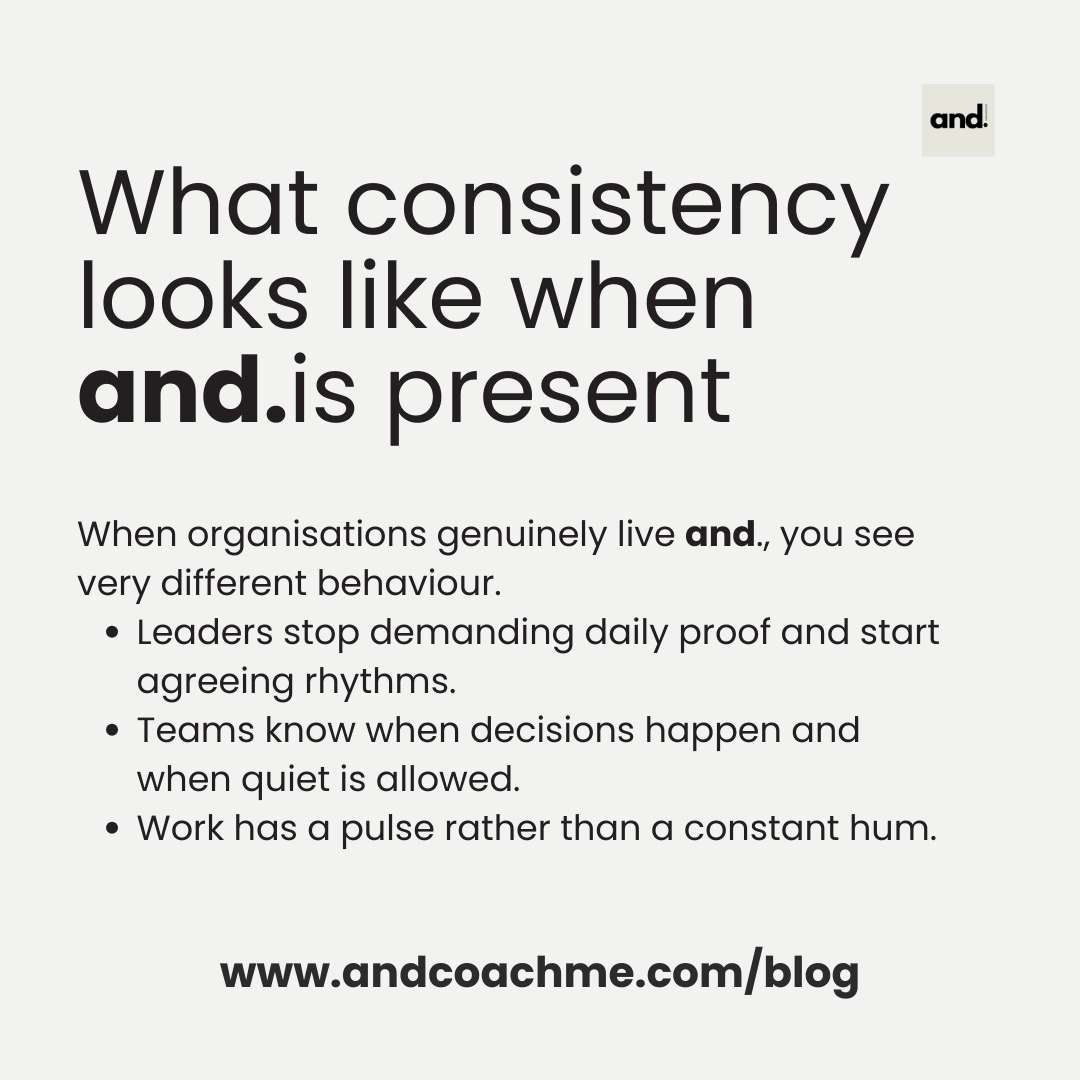
What consistency looks like when and.is present
When organisations genuinely live and., you see very different behaviour.
Leaders stop demanding daily proof and start agreeing rhythms.
Teams know when decisions happen and when quiet is allowed.
Work has a pulse rather than a constant hum.
One organisation we worked with removed daily reporting entirely. Instead, they agreed:
Two clear decision points a week
One shared weekly written top 10 things in the business that week update
Explicit permission to go quiet in between
Leaders panicked briefly. Control always feels comforting. Then something happened.
Decisions improved.
Noise dropped.
Momentum returned.
Result got achieved.
Not because people tried harder. Because the system stopped fighting reality.
The uncomfortable truth about leadership models
A lot of leadership thinking still worships visibility.
Fast responses. Full calendars. Constant availability. It looks impressive. It breaks people quietly. These outdated models were built for industrial work, not cognitive work. For factories, not thinking.
Yet we keep applying them, then acting surprised when humans struggle and. challenges that at the root. Not by offering a better checklist, by questioning the belief that if something matters, it must happen every day.
That belief is not neutral. It is inherited and. it is outdated.
This is not about switching cadence
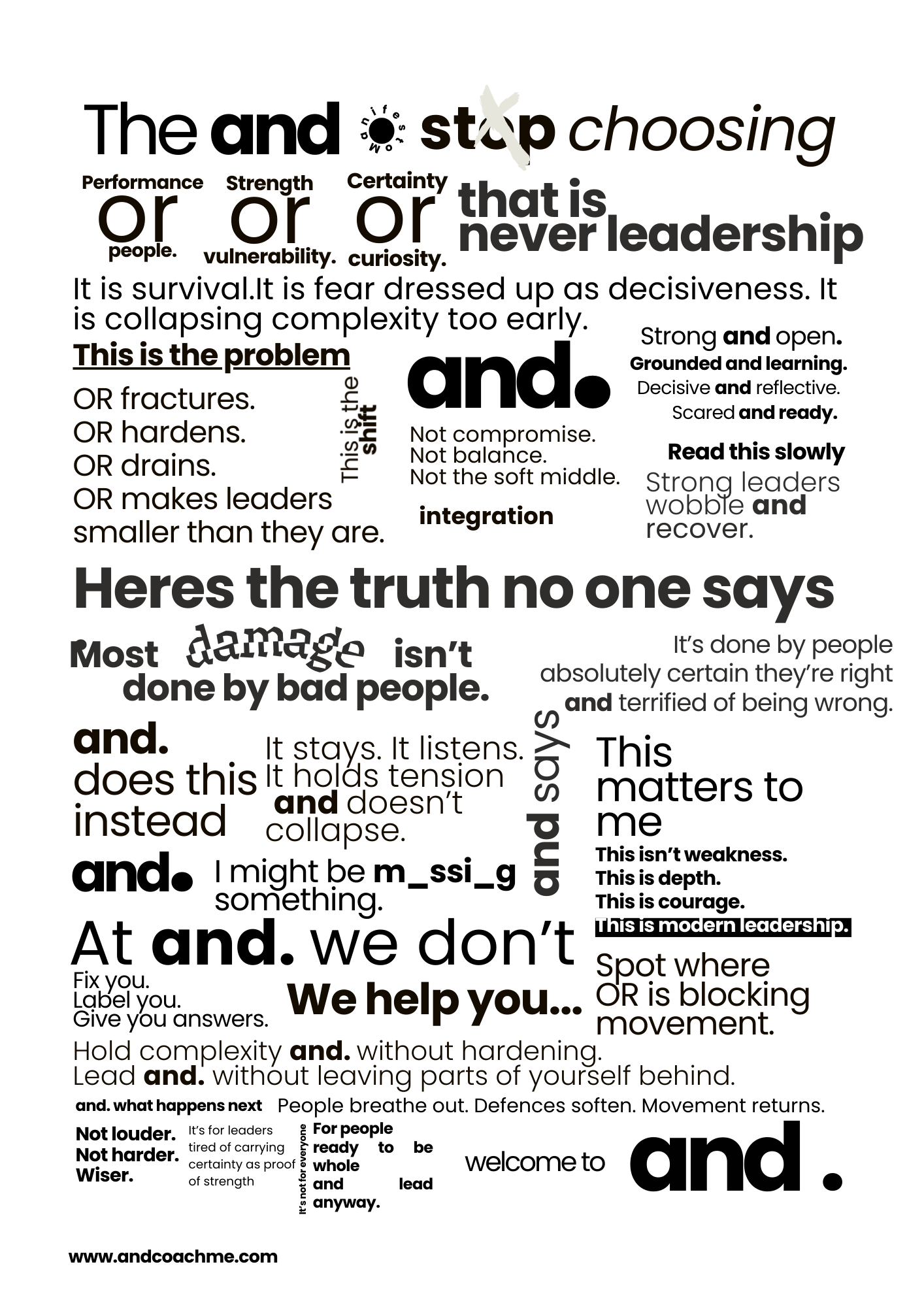
The and. manifesto
This is important. This is not an argument for weekly instead of daily. That would miss the point entirely. This is about recognising that momentum is created through rhythm, not repetition.
Push and pause.
Action and reflection.
Delivery and recovery.
When organisations deny one side of that, people pay the price. Burnout is not a mystery. Disengagement is not laziness. Quiet quitting is not entitlement. They are rational responses to systems that refuse to hold contradiction.
This is the work of and.
At and., we do not help organisations become more efficient at outdated models. We challenge the beliefs underneath them. We work with leaders who are brave enough to ask why daily consistency feels so necessary, and what it might be compensating for.
We sit in the tension rather than smoothing it over. Not on one side. Not on the other.
In the and.
If this made you slightly irritated, good. That usually means you recognised something real.
Research and resourcesBaumeister, R. et al. Research on decision fatigue and cognitive depletion
Harvard Medical School. Studies on ultradian rhythms and human performance cycles
National Institutes of Health. Research into focus, recovery, and cognitive load
Microsoft Work Trend Index. Findings on meetings, attention, and productivity
Newport, C. Writing on deep work, attention, and knowledge work realities
Harvard Business Review. Articles on cognitive overload, decision quality, and leadership behaviour

Whenever I or we as and write collectivley there is always more to say, share and think here are some extra thinking and reflections on real life examples
If as a leader you love less contradiction it’s because
There is a natural tension between speed and quality.
It allows you to believe autonomy or accountability is and option (missing and)
It is your focus performance ignoring humanity.
Pressure of role or what the organisation says it values and what it actually rewards.
The contradiction gets smoothed over. Or renamed. Or quietly pushed down the hierarchy., and then they wonder why consistency never quite holds. Here is the and. truth we see in most businesses real life is disguised in many ways., through outside the meetings meetings, gossip, lack of permissions, boundaries crossed, poor language, behaviours claching to values, poster wall v alues nothing really lived or believed. and fear presented as hope and success . Your organisation is not failing at consistency. It is failing at holding and..
The fantasy of either or leadership
Most leadership systems are built on either or logic.
Either we move fast or we think deeply.
Either we trust people or we measure them.
Either we give freedom or we keep control.
Either we care about wellbeing or we hit the numbers.
These choices feel clean. They feel decisive. They feel like leadership. They are also false.
Because the real world does not operate in clean binaries. It operates in paradox and. paradox does not go away because you ignore it. It just shows up elsewhere. Usually as burnout, disengagement, or passive resistance.
Where consistency quietly dies
Let’s talk about what actually happens inside organisations.
You tell people to be consistent. Consistent leadership. Consistent communication. Consistent standards. At the same time, you fill diaries with back to back meetings. You reward responsiveness over reflection. You promote people who say yes quickly and punish those who slow things down.
So people perform consistency. They show up. They respond. They stay visible.
What disappears is thinking. Integration. Choice. Consistency survives on the surface and collapses underneath.
That is not a people problem, that is a leadership ( we call is leadershit problem. )
The contradiction leaders create and then deny
Here is a pattern we see repeatedly.
Leaders say they want ownership and initiative. They also want alignment and predictability. They say they want innovation. They also want certainty. They say they want empowered teams. They also want immediate answers.
These are not unreasonable desires. They are incomplete ones. Because ownership without trust becomes compliance. Innovation without tolerance for ambiguity becomes theatre. Empowerment without space becomes pressure.
The contradiction is not the issue. The refusal to acknowledge it is.
The keynote moment most leaders avoid
This is usually the point in a room where things go quiet. Because holding and. means leaders have to stop outsourcing tension.
They can no longer say: That is just how the business is. That is just the market. That is just the pace we work at. They have to ask harder questions.
What are we asking people to hold that we are unwilling to hold ourselves?
Where are we demanding consistency while designing instability?
Where are we rewarding one side of the paradox and punishing the other?
This is where leadership stops being positional and starts being relational.
Consistency and freedom do not cancel each other out
Consistency does not come from repetition alone.
It comes from rhythm. Rhythm allows variation and reliability to exist together.
It creates anchors without rigidity.
It gives people something to trust without trapping them. In organisations that understand this, you see things like:
Clear non negotiables and flexible execution.
Shared rhythms and individual pace.
Strong standards and multiple ways of meeting them.
This is and. in action.
Not compromise. Not balance. Co existence.
Real organisational examples of and. at work
We have seen teams where leaders stopped demanding constant availability and instead created clear decision windows= The result was faster outcomes and less noise.
We have seen organisations that reduced meetings and increased written thinking. = Consistency improved because people had space to act.
We have seen senior teams agree what must stay stable and what is allowed to flex = Performance went up and burnout went down.
None of this came from asking people to try harder. It came from redesigning how work actually works.
Why senior leadership is the constraint
This is the part that rarely gets said directly. Most organisations do not struggle with AND because their people cannot handle complexity. They struggle because their leaders are uncomfortable holding it.
The outcome leaders collapse paradox into certainty.
They simplify too quickly.
They choose one side and call it strategy. and. the people in the organisation pays the price.
The and. leadership shift
and. leadership is not about having better answers. It is about holding better questions for longer.
Questions like:
What needs to be consistent and what needs to adapt?
Where do we need clarity and where do we need choice?
What are we stabilising and what are we deliberately leaving open?
This is not indecision. It is maturity.
A final positive agitation
If consistency feels fragile in your organisation, stop demanding it. Look instead at where contradiction is being denied, avoided, or pushed onto others.
The work is not choosing sides.
The work is designing systems that can hold both.
Consistency and freedom.
Performance and humanity.
Structure and adaptability.
and is not a nice idea.
It is the only way complex organisations survive without breaking people. This is the work we do.
In rooms where leaders are ready to stop pretending the paradox is not there.
In keynotes that do not offer comfort but create clarity.
In leading and solving by refusing to simplify what is inherently complex.
If you want this talk to us.
Not on one side. Not on the other. In the and.
How this shows up at board-level
Consistency is your governance problem, not your people problem.
Boards talk a lot about consistency.
Consistent delivery.
Consistent leadership.
Consistent culture.
What boards rarely talk about is the contradiction they author and then delegate. Because here is the reality thats’ ignored as Boards act a lot on theory and not reality.
Most inconsistency in organisations is not caused by capability gaps, motivation issues, or weak leadership layers. It is caused by unresolved paradox at the top.
The contradiction boards create and then outsource
Boards routinely ask for:
Growth and cost control.
Speed and certainty.
Innovation and predictability.
Empowerment and risk elimination.
These are not unreasonable expectations.
They are incomplete ones as they require and thinking and leading behaviours to hold them together.
When boards do not hold the paradox, it cascades.
Senior leaders turn tension into targets.
Middle managers turn targets into pressure.
Teams absorb the contradiction personally.
and. consistency quietly collapses.
What boards reward and what boards say rarely align
Look honestly at what gets rewarded.
Speed over judgement.
Confidence over reflection.
Delivery over integration.
Certainty over sense-making.
Then look at what boards say they want.
Better decisions.
Stronger leadership.
Sustainable performance.
Engaged people.
These things cannot coexist without design. Boards are not neutral observers here. They are system designers.
Consistency does not come from oversight alone
More reporting does not create consistency.
More dashboards do not create alignment.
More scrutiny does not create trust.
Consistency comes from clarity about what must be stable and what is allowed to move.
Boards that enable and. do a few things differently.
They are explicit about non-negotiables and equally explicit about where discretion lives.
They tolerate ambiguity long enough for better decisions to emerge.
They stop demanding certainty in environments that are inherently uncertain.
This is governance maturity, not softness.
The board-level question most avoided
If your organisation struggles with consistency, ask this before you ask anything else.
What contradictions are we refusing to hold at this level?
Where are we asking for both and refusing to acknowledge the cost of that demand?
Where are we punishing leaders for slowing things down while criticising them for poor judgement?
Until that is addressed, every consistency initiative will be cosmetic.
A board-level provocation
If consistency is fragile in your organisation, it is not because people lack discipline. It is because the system you govern is asking for and while only rewarding either. Boards that understand this stop demanding behavioural change and start redesigning conditions. That is not operational interference. That is leadership.
How this shows up in middle management
You are not failing. You are holding the tension no one names.
Middle managers sit in the most dishonest place in most organisations.
They are told to empower their teams and deliver certainty upward.
They are told to protect wellbeing and hit non-negotiable targets.
They are told to encourage autonomy and enforce compliance.
and then they are judged as if these tensions do not exist. They do, and they are not mideel managers fault.
Why consistency feels hardest in the middle
Middle managers are asked to make AND work without authority to redesign the system.
They inherit strategy without context.
They inherit targets without trade-offs.
They inherit pressure without permission to slow things down.
So they translate.
They absorb contradiction so their teams do not have to.
They buffer uncertainty.
They carry emotional and operational weight quietly.
Then they are told to be more consistent. This is not a resilience issue. It is a structural one.
The trap middle managers fall into
Most care often respond by doing more.
More checking.
More reminding.
More availability.
More personal sacrifice.
This creates short-term stability and long-term exhaustion. Consistency improves briefly and then collapses again. Not because you failed. Because they became the system.
The and. shift for the middle
Middle managers cannot resolve organisational paradox alone, they can stop internalising it as personal failure.
and. leadership in the middle looks like this.
Naming tension instead of smoothing it over.
Being clear about what you can control and what you cannot.
Creating rhythm locally even when the wider system is chaotic.
It means saying things like:
This is stable and this is changing.
This decision is fixed and this one is open.
This matters now and this can wait.
That clarity creates more consistency than pretending everything is equally urgent ever will.
Where middle managers still have agency
Even without formal power, middle managers shape lived experience.
They can create breathing space in meetings.
They can reduce noise instead of amplifying it.
They can protect thinking time instead of rewarding constant responsiveness.
These are not small acts. They are acts of leadership. Consistency grows where rhythm exists.
A challenge, not a comfort
If you are a middle manager feeling inconsistent, stop asking what you are doing wrong. Ask instead what contradiction you are being asked to carry alone. Then decide where you will stop compensating for a system that refuses to acknowledge it. That is not disengagement. that is leadership maturity.