

You are never authentic!
This could also be titled Everybody lies all the time or What everyone ought to know about honesty and authenticity.
You Are Never Authentic
Let’s stop pretending.
Let’s stop pretending that we’re honest.
Let’s stop pretending that authenticity is some kind of virtue badge.
The reality?
We lie.
A lot.
And we’ve been trained to do so since birth. Some of the earliest “truths” we’re fed Father Christmas, the Tooth Fairy, the Easter Bunny are lies we collectively agree to keep telling. It's cultural, it’s comfortable, and it’s how we learn to lie with a smile.
So let’s cut through the fluff. The dystopian aspect of society is we are literally told, brought up and live in a lie.
How we get stuck in a lie.
Let’s be candid here. We all lie.
We lie to fit in.
We lie to avoid conflict.
We lie to manage people’s emotions.
We lie to keep the peace (or preserve the chaos that keeps us safe).
We lie to ourselves to avoid the brutal discomfort of being honest.
We lie to save face
We lie to protect others
We lie to deflect (pain, hurt, truth, reality etc.)
We lie because of shame and blame
We lie because everyone else does
We lie because it’s ok too in society
We lie because honesty is harder
We lie because it’s so easy too
We even have definitions of “white lies” our validation of we are being honest just not sharing everything.
And the most ironic part?
We still say, “I’m just being honest.”
But it’s not honesty.
The “authentic self” we talk about in leadership books and Instagram quotes? That’s mostly performance. We tailor who we are to who we think we need to be to be liked, to be accepted, to be right, to be safe.
So when we say we value honesty, let’s ask:
When was the last time you told the full truth?
When was the last time you filtered it to protect an image/another/yourself?
Where to start a simple solve is admitting it. You’re lying more than you think.
The data is brutal.
Psych studies show we start lying as early as 18 months old.
We lie in relationships because truth might jeopardize connection.
We lie at work to avoid awkward feedback.
We lie to ourselves to avoid the raw mirror of growth.
Why?
Because honesty is hard.
Because being authentic is messy.
Because truth disrupts the comfort zone.
And leadership? Leadership demands both.
If you’re still hiding behind:
Aague “nice” feedback that keeps your team unclear,
Saying “I’m fine” when you’re falling apart.
Or ghosting hard conversations with “l will do this later”...
You’re not leading.
You’re managing perception.
So what now? Simplify it. Strip it back. Tell the damn truth.
Let’s stop complicating honesty with semantics.
Yes. There are nuances.
Yes. Not every truth needs to be said right now.
Yes. Delivery matters.
But no, honesty doesn’t mean cruelty.
It means realness.
With compassion.
With purpose.
Authenticity ≠ full disclosure.
Honesty ≠ unfiltered opinion.
Instead, ask yourself:
“What am I avoiding by lying (or withholding) right now?”
“What fear am I managing through omission?”
“Am I saying what’s true, or what keeps me safe?”
As leaders, as humans we must practice radical honesty with ourselves first, before we can be “authentic” with others.
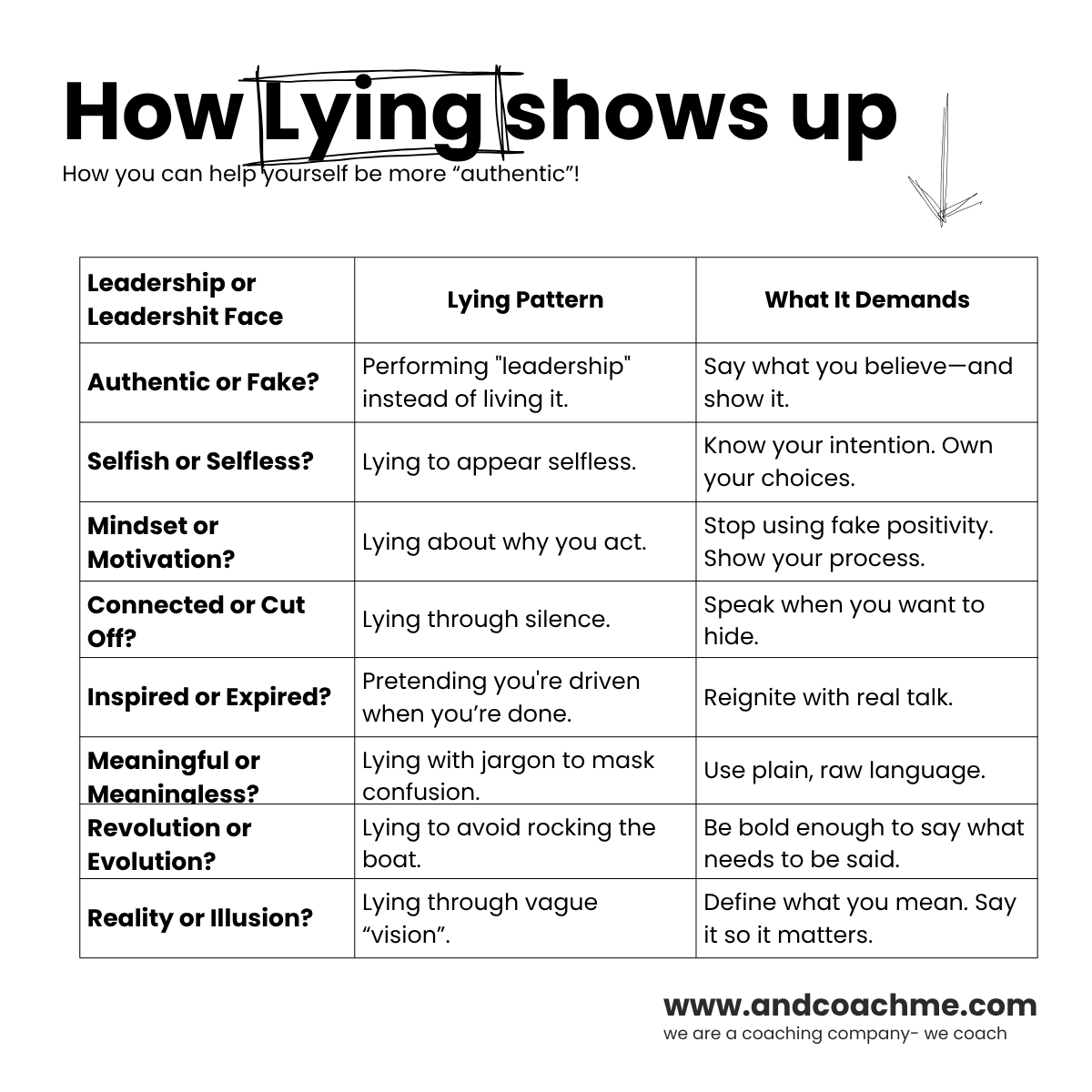
When you get honest, actually honest things get clearer, faster and you thrive.
Leadership transforms when:
Feedback becomes real-time, not avoided.
Values aren’t stickers they’re tested in action.
Trust is built on courage, not convenience.
But honesty doesn’t thrive in ambiguity.
That’s why the 8 Faces of Leadership Questions matter so much here:
Truth bomb.
You can be honest.
You can choose to be clear.
You don’t call yourself “authentic” until you start telling yourself the truth.
Because the biggest lie we live in isn’t the ones we tell others.
It’s the one we believe about ourselves.
You’re not fake.
You are filtered.
Ready to get real?
Final Reality Check:
“We are our own judges about our own honesty, and that internal judge is what differentiates psychopaths and non-psychopaths.”
— Dan Ariely, Duke University
Want to get real? Start here:
“Cut the Leadershit” 3-mins mini audit
See where your leadership masks your honesty.
Because if you can’t tell the truth, you can’t lead.
Let’s stop lying.
Let’s stop pretending we’re not lying.
Let’s lead better.
More to poke your brain:
Ian Leslie’s Born Liars – Deep dive on why lying is so deeply human.
Adam Grant on rationalizing vs. rationality – Check the tweet
Malcolm Gladwell’s Talking to Strangers – It’s all deception and assumption.
In transparency the original post is here
Honesty feels difficult
Honesty hurts
Not telling an employee they are poor at their job because you like them.
Not telling your partner, spouse, significant other that.
Telling your children when something has happened an abridged version to ease the pain.
Societal Impact
We are surrounded by lies from all aspects of life- lies could be interpretation or belief too so the distortion gets easily applied. The film industry has for decades created films about lying and the traditional film format and script is built on someone lying (the baddie versus the good the truth) So many religious contexts and comedic films are based on lying or not! The invention of lying, Liar Liar, Yes Man ultimately the more serious ones are To Kill a Mocking Bird,
We know what a lie is, so why do we keep on lying?
We all lie, and if you say you dont you are lying?! In relationships (and the closet ones, from personal and romantic to work relationships we lie as we assume we can manage the outcome. One particular study completed by Kelley &Thibaut, 1978 show that individuals are less likely, to tell the truth when the outcome (assumed) become disadvantageous - reciprocity, avoid punishment, intimacy (connection, desire to be liked etc.)
Ever said when someone is mid-sentence
Yes I heard you, Yes I am listening (when you are not)
You look nice (and not look)
Yes I noticed that (you hadn’t and just wanted to be part of a conversation)
Beliefs and lying
The external factors matter when it comes to lying
The Authenticity lie
I love a Seth Godin quote on authenticity that says we are only very authentic when we are a small baby as there is no other time in our life we are not seeking external recingtion. The studies show that we can start lying as young as 18 months old!
Lying is a choice
Neurologically and personally. We can choose not to lie. The impact of lying is that the more you lie the easier its gets and you continue (easiest path and all), even when the outcome is not what you wanted the act of lying is easier than the act of being honest, truthful, candid, open, vulnerable.
““We are our own judges about our own honesty, and that internal judge is what differentiates psychopaths and non-psychopaths.”.”
— Ariely, psychologist (Duke University)
Adam Grant (Author Think Again) also uses the application and key semantics of rationalizing and rational thinking which we can connect directly to the need to lie. This connection can also be how we respond - check out Grant's quiz on giving, taking, matching? Fun and the outcome is only as honest as you are! A good test to start.
“Rationalizing is searching for justifications after you’ve reached an opinion or decision. Rationality is seeking the best logic and data before you commit—and staying open to changing your mind.”
— Adam Grant
The ultimate outcome is that we, as the individual, are fully responsible for our lying capacity, commonality, repetitiveness, comfort and rational interpretation of what a lie is. We all make judgements when it’s ok (rationalizing and justification) our own actions and also that of others. We contradict ourselves through familiarity and also if we like someone. We think we are protecting ourselves or others.
So be wary when you say you have values of integrity and honesty and reflect back on the last lie you said. (Probably a few moments ago!), Then if you can break down the rationalisation you made to allow yourself to lie. Lying has a neurological impact on us and we have to be aware of that as its importance is that we can be deceiving ourselves the most. The ability to be self-aware, open, reflective, rational (not rationalising) and
Research, References and Resources
Ian Leslie Born Liars- A superb reference and debate discussion in his book (also check out his book Conflicted and Curious both superb books)
Relational and romance lying https://www.researchgate.net/publication/240707089_Lying_to_the_One_you_Love_The_Use_of_Deception_in_Romantic_Relationships
https://www.washingtonpost.com/news/speaking-of-science/wp/2018/08/24/why-liars-lie-what-science-tells-us-about-false-statements/
Adam Grant’s work is intriguing and thought-provoking - https://twitter.com/AdamMGrant/status/1428688973338222597
Brains ability to adapt to lying https://pubmed.ncbi.nlm.nih.gov/27775721/
An intriguing study on the link to dishonesty, lying and the rewards or benefits through neuro and cognitive processes. https://pubmed.ncbi.nlm.nih.gov/29582512/
The connection to gain through lying (that film’esque outcome of lying and never being found out) exists in how we focus on our internal benefit before the risk or impact to self https://pubmed.ncbi.nlm.nih.gov/32985527/
Malcolm Galdwell’s book Talking to Strangers is a superb study and insights into how we distort our capacity to try, lie, judge, assume and allow others to be dihinest of we know them or not.