
If your values only exist when it’s easy, you don’t have values. You have preferences you can afford.
Money doesn’t change your values. It reveals they were never fixed.
This sits in all of us
Money is the root of all evil.
Money is not a bad thing.
Money gives you choices.
Money makes the world go round.
All of it exists. None of it stands alone. Money distortion lives in all of us.
Context shapes you. Own it
Context matters. Not as positioning. Not as performance. Fact.
I live a life many would call luxury. Roof. Water. Clothes. Bills paid. Sleep intact.
Safe. Warm. Choice in where I live. I own a home. I travel. I stay well when I do.
This shapes me and still I manage my relationship with money almost daily.
Because money distorts. Quietly. Consistently. Systemically. Not always loudly. Not always in a way you can point at and say “that’s it”.
More like a slow fog that makes sharp thinking feel optional. So no, I’m not writing this from a “money is bad” pedestal. I’m writing this from inside it, and I’m writing it because it keeps showing up in leadership. Not as theory. As pattern. As consequence. As culture.
This isn’t anti-money
Money is a human essential.
Purpose does not remove that. Meaning does not remove that. Living costs money. Existing within any system costs money. Even opting out costs money.
In business the language is clear.
Revenue. Profit. Margin. Cashflow.
Money is a systemic indicator of success. Not the only one. Still present and at the same time we live with extremes.
Levels of wealth that cannot be spent in a lifetime. Individuals with the capacity to alter global outcomes. Poverty and hunger existing alongside excess.
Money isn’t the villain. Money is the amplifier.
It turns up whatever is already running you: fear, ego, avoidance, control.
Money can fund values.
Money can also silence them.
Both are true. Which is annoying, and real and, and!
Here’s the truth most avoid
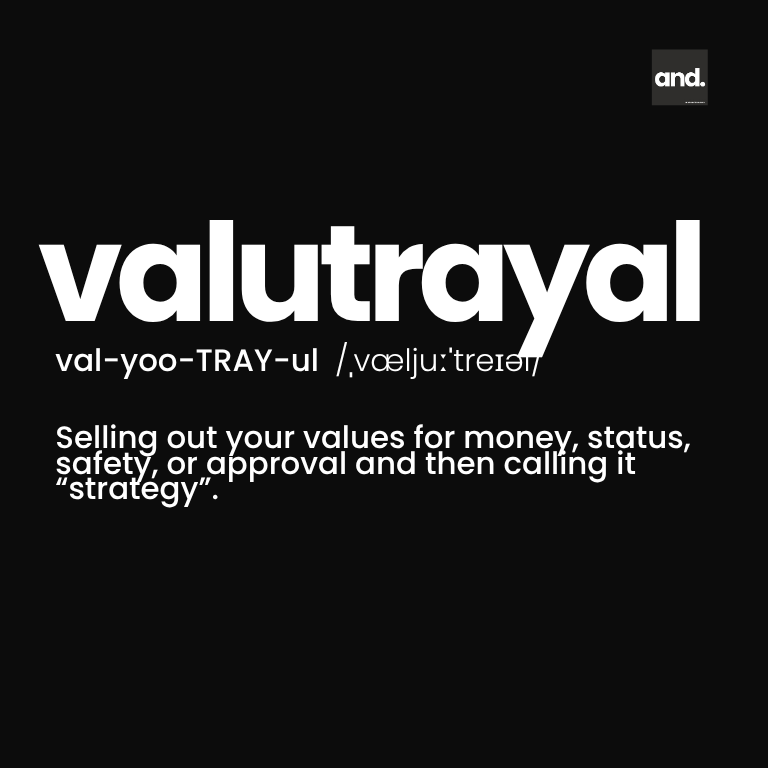
Values aren’t lost. They’re traded. Not by monsters. By decent people under pressure, and if you want to know why it happens so often, here’s the unglamorous answer:
Most people think externally more than internally.
We look outward for cues. What gets rewarded. What gets punished. What keeps the money coming. What keeps me in the room. What keeps me safe. Then we call it “being realistic”.
Leadership isn’t being realistic. Leadership is being responsible, and if you want the simplest definition of leadership I know, it’s this:
A leader helps other people succeed. That’s it. That’s the job.
Let’s make sure I am being clear when I say “values”, I don’t mean the words you chose in a workshop. I mean: what you protect when it costs you.
What you do when no one is watching?
What you choose when you feel exposed?
How you treat people when money gets loud?
That’s what we’re talking about.
Where mine started
I spent decades dismissing money as a driver. Not from principle. From grief.
My first husband died by suicide with astronomical debt. We did not have much. I did not know those debts existed. I did not know how they were created. Over time one thing became clear. This was not about numbers. This was about belief. Someone convinced that their value sat in money. Without it they were less. With it they would finally be enough.
Thirty years later I still do not have the full why. What I do have is this. He died for money. He did not see his value as a human being. A life reduced to a number. That does not leave you. It alters how you see everything that follows.
So yes, I have a lens, and. I’m not pretending I don’t.
Where this shows up
This connects directly to leadership. This is not theory. This is drawn from repeated conversations, multiple contexts, the same pattern.
Values exist. They are stated. Written. Shared.
Then they are overridden. Not loudly. Not dramatically. Quietly. Repeatedly. You feel it first. The moment where something does not sit right.
The internal signal. Then the override.
The override moment
External thinking wins.
Optics wins.
Speed wins.
Fear wins.
Numbers win.
Avoidance wins.
Values get “handled later”.
Later rarely arrives.
How the is shows up..
You value family. You take the promotion you worked for. More hours. More travel. More pressure. More income. Less presence.
You explain it to yourself. You value freedom.
It can be you build a business. It takes more time than any role before it.
It requires more of you than expected. You explain it to yourself. You value people. You make decisions based on cost. Roles removed. Budgets cut.
Language softens the reality. You explain it to yourself.
Before anyone tries to turn this into a simplistic morality tale: this is not always wrong.
Sometimes those choices are real. This is where it becomes distorted, very and. Money gets louder than values, and instead of naming the trade, we justify it.
We make it sound responsible.
We make it sound inevitable.
We make it sound like leadership.
Good people do harmful things
Most harm in organisations isn’t done by cartoon villains in shiny suits. It’s done by good people.
Good people who are tired.
Good people who are scared.
Good people who carry payroll, costs, pressure, reputation, expectation.
Good people whose nervous systems are running the show.
They don’t wake up and decide to betray their values.
They trade them in small increments:
They don’t challenge the comment because “now isn’t the time”.
They keep the high performer who is toxic because “we can’t afford to lose them”.
They soften the language because the truth would be uncomfortable.
They make the decision fast because slowness feels like weakness.
They avoid consultation because being disagreed with feels dangerous.
They reward the behaviour they say they hate because it hit the number.
It doesn’t feel like selling out when it’s happening. It feels like coping, and if you repeat coping choices long enough, you don’t just create an outcome.
You create a culture.
Pressure doesn’t remove values
Leadership carries weight.
Payroll.
Rising costs.
Other people’s lives.
Personal exposure to failure.
Under pressure, values are not always removed.
They are deferred.
Put aside. Handled later.
Later rarely arrives.
Decisions become reactive.
Self-protection increases.
Short-term thinking overrides long-term intent.
Repeated often enough this becomes normal.
Then it becomes culture.
Hard decisions vs fear decisions
Not every tough decision is a values failure.
Reality is real and. there is a difference between a hard decision and a fear decision.
-
clear trade-offs named out loud (no fantasy)
consultation where it’s possible (input, not consensus)
steadiness before and after
dignity protected for the people impacted
ownership: “this is on me”
learning: “here’s what we missed / here’s what we’ll change”
-
speed for the sake of control (“we need to move NOW” when we don’t)
secrecy disguised as “strategy”
narrative control (“here’s the story you’re allowed to repeat”)
scapegoating (“someone has to carry the discomfort so I don’t”)
sudden certainty (certainty as a nervous system response, not a data response)
optics over impact
a leader who gets colder, sharper, more distant—because they’ve gone into self-protection
If you recognise yourself in that second list, I’m not here to shame you, its not constructive criticism either that’s poor feedback terms . I’m here to tell you the truth: That isn’t leadership. That’s fear driving with a leadership badge on.
the and. lexicon 2026
Fractional semantics
This is where most thinking collapses into either/or.
Values or profit.
People or performance.
Freedom or responsibility.
People or profit.
False structure.
Fractional semantics holds multiple truths at the same time without collapsing them into a single simplified answer. Not compromise. Not dilution.
Precision. This and this.
In tension.
In relationship.
Not resolved. Managed. This is where distortion reduces. Because money is not removed.
It is placed. It has a seat. It does not get the microphone.
and. as method
At and. this is not conceptual. This is operational.
We build and apply filters that hold tension in real time.
Pre decision. During. After.
Questions are not decorative. They are structural.
Why are we doing this?
What does this do for everyone involved?
How are we showing up in action, not language?
What happens if we choose differently?
Money sits inside this. It has a place. It does not dominate the space.
Consistency is not rigid adherence. Consistency is returning to the filter repeatedly.
When money is tight
This is where values stop being a statement and become evidence. When money is tight, lived values look like:

Transparent comms (without dumping panic)
Not “everything is fine”.
Not “here are all my fears, good luck.”
But: here is what’s true, here is what we know, here is what we don’t, here is what we’re doing next.

Shared pain, not outsourced pain
If cuts are needed, the question is not only “who goes?”
It’s also: what do we stop, what do we reduce, what do we as leaders carry first?
If leaders protect their comfort and outsource the pain, don’t call it values.

Protected dignity
No surprise humiliations. No last-minute ambush invites. No language that sanitises harm so leaders can sleep at night.
How you do it matters.
Clear priorities (one of them)
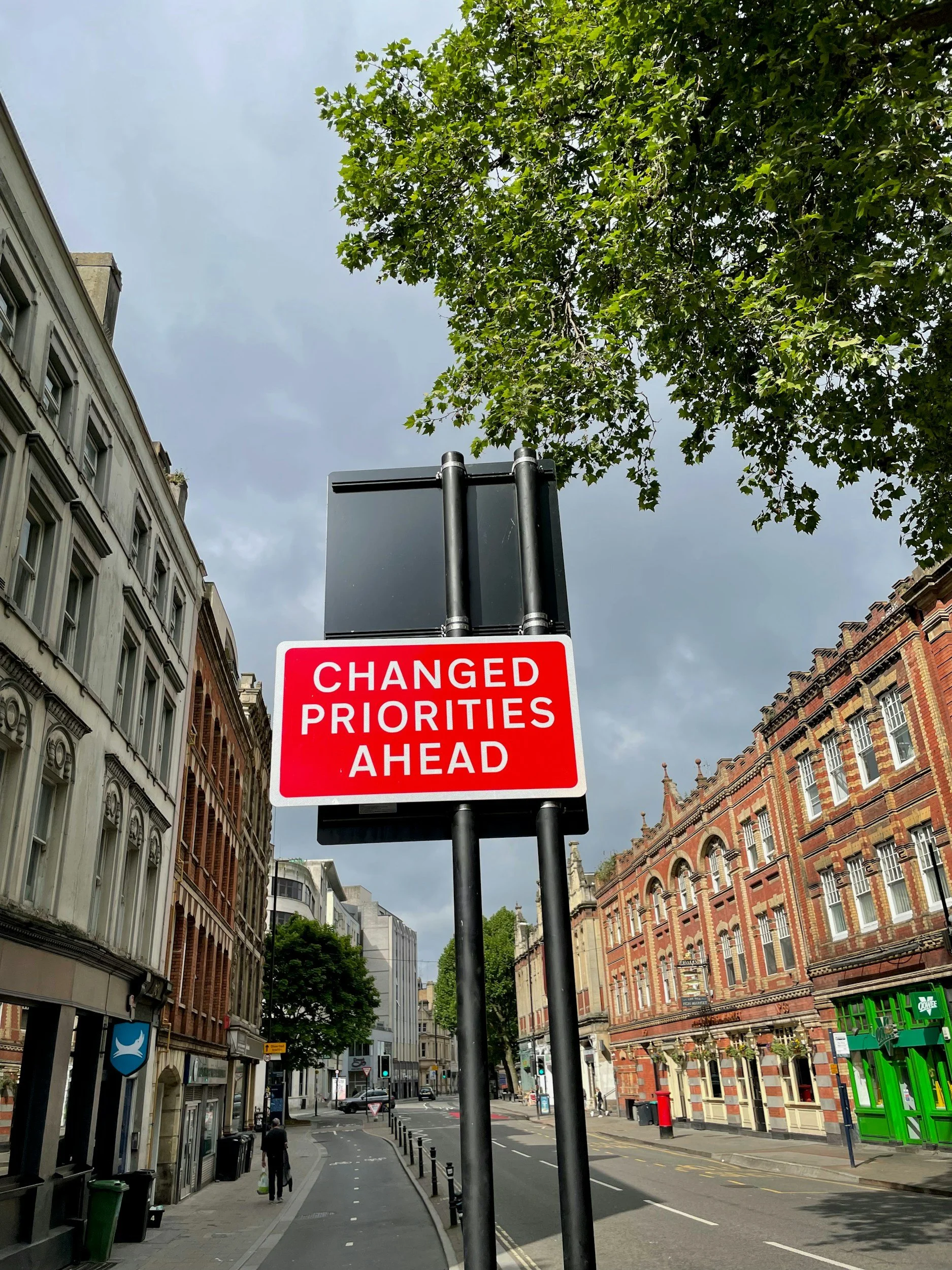
Values under pressure choose focus.
What stays. What stops. What matters most. What we will not sacrifice. If everything is a priority, your values are a wishlist.

Honest trade-offs (no moral theatre)
Sometimes you cannot keep every promise. Fine, and say it. Name it. Own it.
A leader doesn’t pretend the cost isn’t there. A leader carries it.

Connection as leadership discipline
Connection isn’t soft. Connection is data. If you are disconnected from your people, you are leading a story, not a reality.
If you want results that last, connection is not optional. Because a leader helps other people succeed. That’s the mechanism.
This is where it gets uncomfortable
There is a gap between stated values and lived behaviour.
This is visible. In organisations. In leadership. In individuals. Not occasionally. Regularly.
Decisions framed as necessity that are preference. Values spoken that are not upheld when tested. This is not a failure of intelligence. This is avoidance.
And avoidance loves money because money gives you a socially acceptable excuse.
“We had no choice.”
Sometimes you did.
Sometimes you didn’t.
But if you never even asked the question, you weren’t out of choices. You were out of courage.
Sit with this
Where does money override your values specifically?
What decision have you justified recently that does not sit right?
What are you not willing to compromise?
Is that actually true?
And here’s the one people hate most:
What do you reward that you claim you don’t value?
Because values aren’t what you say. Values are what you protect, and what you’re willing to lose to protect it.
Values aren’t lost
So are values lost? No.
Values aren’t lost like keys down the back of a sofa. They’re traded like currency. Quietly. Repeatedly. With reasons that sound responsible, and I’m done being polite about this part:
If your values disappear the moment money gets tight, they were never values. They were a preference you could afford.
Most people aren’t trying to be cruel. They’re attemtpting to be safe, and if your safety requires you to shrink other people, silence truth, or pretend harm didn’t happen, that isn’t safety. It’s self-protection dressed as leadership.
Values cost.
Time.
Money.
Opportunity.
Status.
Certainty.
Convenience.
Sometimes profit.
If there is no cost there is no decision. If there is no decision there is no value.
and here’s the part that makes this personal, because it’s where most people try to wriggle out:
You usually know in the moment.
You feel it.
The stomach-drop.
The flinch.
The split second where you choose the clean thing… or the easy thing.
Then you tell yourself a story so you can live with it.
I am not interested in the story, its in the choice that I am curious about.
Because values aren’t what you believe. They’re what you hold when it costs.
So the question isn’t “do I have values?”
The question is:
What am I willing to pay to keep them? andwhat am I currently paying to abandon them?
Because if you can’t answer that, you’re not lost. You’re just externally led, and leadership, real leadership, starts inside.
If you can’t hold your own tension, you will export it to everyone else. Not a title. Not a performance. Not a revenue line. A decision. Again and again and again.
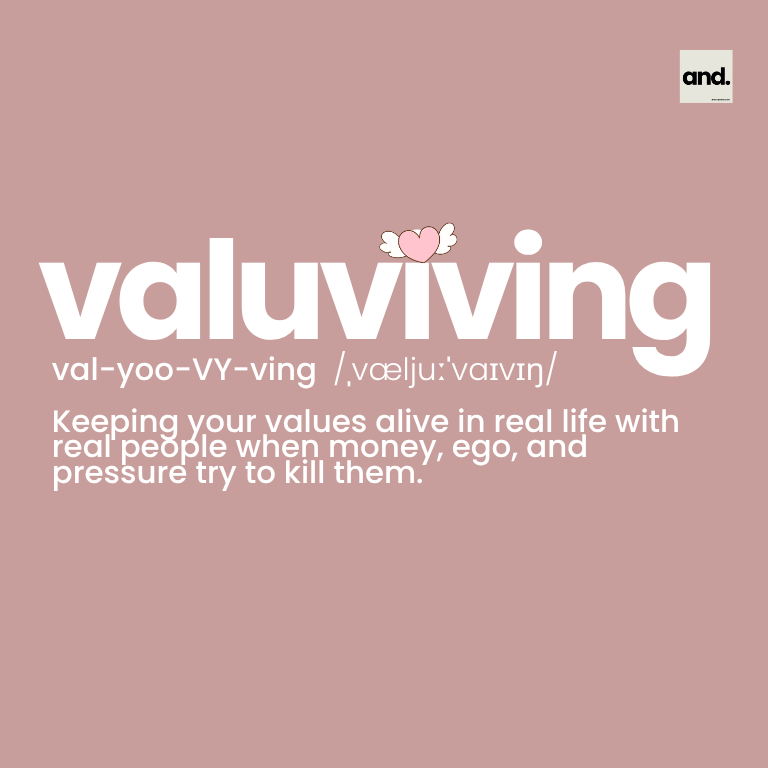
the and. lexicon 2026
The work: Application. Not theory.
This is where most pieces stop. Insight. Agreement. Discomfort. Then nothing changes. So here is what this looks like in practice.
One situation. Real. Anonymised.
Here is the real and. coaching situation
A leadership team. Growing business. Strong revenue. Tight margins.
They had a high performer.
Delivered consistently.
Brought in money.
Hit numbers.
They also:
Created friction across teams.
Undermined peers.
Dismissive in meetings.
Multiple complaints.
Nothing extreme enough to trigger a formal process. Enough to be felt everywhere.
Leadership knew and did nothing.
Why.
Because they could not afford to lose them.
That was the line.
The first version of the story
“We need to be realistic.”
“This is just how high performers are.”
“Now isn’t the time to destabilise revenue.”
“We’ll deal with it later.”
Later did not come.
What did come:
Lower trust.
Reduced collaboration.
Silent resentment.
Good people starting to withdraw.
No one said “we are trading our values”, they said “we are managing the business”.
The and. filter in action
We brought it back to the filter. Not abstract. Specific.
Why are we doing this. Really?
Answer: to protect revenue and avoid disruption.
What does this do for everyone involved?
Answer: protects one person. Costs many.
How are we showing up. In behaviour, not words.
Answer: we say we value people. We are rewarding behaviour that damages them.
What are we not saying?
Answer: we are choosing money over values in this moment.
That was the coaching right there. Not comfortably. Not neatly. Clearly.
The resistance (and why it doesn’t happen or change )
This is where people expect a clean pivot. There wasn’t one. The resistance was real.
“What if revenue drops.”
“What if we can’t replace them.”
“What if this creates more problems than it solves.”
All valid. None of them removed the trade. They just made the cost visible.
The decision
They did not rush.
They did not perform certainty.
They made the trade explicit.
Then chose.
Direct conversation with the individual.
Clear expectations. Behaviour named, not softened.
Support offered. Timeline agreed.
and also a line. If behaviour did not change, they would exit them. Even with the revenue risk.
What changed
Not instantly. Not perfectly.
Behaviour improved in the short term.
Then slipped.
They followed through.
They exited the individual.
Revenue dipped.
Temporarily.
What shifted:
Trust increased.
Collaboration improved.
Energy changed.
People spoke more openly.
Performance recovered.
Differently.
More evenly distributed.
Less dependent on one individual.
and this part matters most, the organisation learned what actually mattered. Not what was written. What was done when it cost something.
The work is not about getting the “right” answer.
This is about making the trade visible. Holding the tension long enough to choose deliberately. Not reactively. Because the damage is not in the hard decision.
The damage is in the unacknowledged trade that repeats.
That becomes normal. That becomes culture.
Do the work
-
Audit what you reward (not what you say)
Name the trade-offs out loud
Decide what dignity looks like here, before pressure hits
Put money in the room, but don’t give it the microphone
Keep returning to the internal filter: why, what, how, impact, cost, consequence
-
Run it through this, properly:
Why are we doing this?
Who does this actually serve?
What does this cost (all costs prople, process, profit, trust keep going the cost list is big!)?
What are we not saying?
What are we choosing to protect?
Then decide.
Not from comfort. From clarity.
Because values don’t disappear over time. They disappear in moments you overlook one decision at a time.
Work with us and let’s make money and values work for you
Experience us get our free leadership reThink coaching yep totally free, www.andcoachm.com/hub
Resources (evidence for and against, because we don’t do lazy takes)
If you want more than opinion, here are some useful rabbit holes. Evidence that pressure and money can distort values and behaviour and If you only read things that agree with you, this piece becomes comfort, not challenge.
Behaviour under pressure and scarcity
Income and wellbeing research: money can reduce stress and increase agency up to a point (Kahneman/Deaton and the later debate/updates)
Money as a values-enabler: wages, safety, training, time, care money can fund the conditions for dignity and performance
The issue isn’t money. It’s identity, incentives, and fear-led decisions
Mullainathan, S. & Shafir, E. (2013) — Scarcity scarcity reduces cognitive bandwidth, drives short-term decisions
Shah, Mullainathan & Shafir (2012) — Some Consequences of Having Too Little tunnelling effect under pressure
Scarcity mindset research: how “not enough” narrows thinking and drives short-term choices (Sendhil Mullainathan & Eldar Shafir)
Power and empathy / entitlement shifts (Dacher Keltner and related research)
Goodhart’s Law: when a measure becomes a target, it stops being a good measure (targets can quietly destroy culture)
Moral licensing: saying/doing something “good” can unconsciously give permission for something inconsistent later
Evidence against “money ruins everything” Ethics and decision distortion
Bazerman & Tenbrunsel (2011) — Blind Spots gap between values and behaviour
Gino, F. (2013) — Sidetracked how context distorts ethical decisions
Bandura (1999) — Moral Disengagement how people justify harmful behaviour
Money, power, and behaviour shifts
Keltner, D. (2016) — The Power Paradox power reduces empathy, increases self-focus
Piff et al. (2012) — Higher social class predicts increased unethical behaviour
Measurement distortion
Goodhart, C. (1975) — Goodhart’s Law
Strathern, M. (1997) — “When a measure becomes a target…”
Money and wellbeing (counterbalance)
Kahneman & Deaton (2010) — income vs emotional wellbeing
Killingsworth (2021) — challenges the plateau idea
Values theory
Schwartz, S. (1992) — Theory of Basic Human Values
Bardi & Schwartz (2003) — values vs behaviour link
Friedman (1970) — profit as primary responsibility
Jensen (2002) — value maximisation as system alignment
Becker (1976) — rational self-interest